Every Bit of Volleyball, Connected: How the Community Is Building VolleyLens
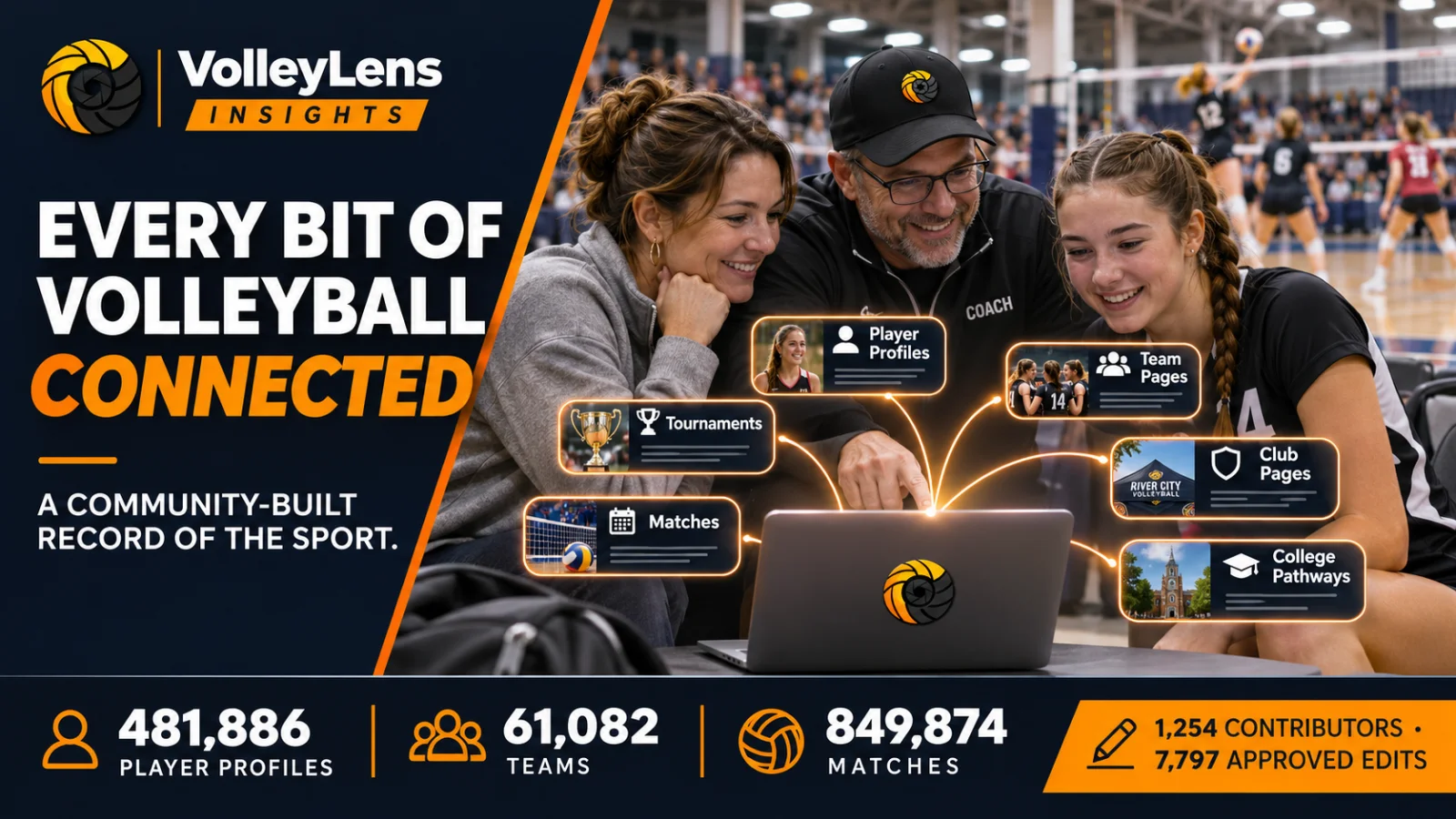
VolleyLens links 481,886 player profiles, 61,082 teams, 7,717 clubs, 3,995 tournaments and 849,874 matches into a single connected record of club volleyball — and the parents, coaches and directors inside it are the ones who keep it honest. This is what we are building: every question about the sport answered in one place, from a first 12s roster to a college program.
Here is why that record exists nowhere else, how the community is building it, and where it goes next.
Volleyball’s memory lives in spreadsheets
Most of what the sport knows about itself is scattered and private: a club’s results in one director’s spreadsheet, a roster in a group chat, a recruiting history in a parent’s notebook, a tournament bracket in a PDF that disappears on Monday. Opinion-poll rankings fill the gap with vibes. None of it connects, and almost none of it survives the season.
One connected record
VolleyLens is built the opposite way: every piece links to every other piece. A player connects to each team they played across the years; each team connects to its club, its tournaments, its matches, and its state and USAV region; and each result feeds a rating that connects back to the player.
Walk it through: open a setter’s profile and you can follow her from a 13s roster, up to the 16s team she moved to, to the club that fields both, to the tournament where that club finished third, to the match that decided it, to the college-club program she commits to. Nothing in that chain is retyped — it is one record, seen from different angles. That connectedness is the product.
Built with the community
A connected record is only as good as the people maintaining it, so VolleyLens is built to be corrected. 1,952 people have claimed roughly 2,000 player profiles; the directors of 64 clubs have verified and taken over their club pages; and 1,254 contributors have submitted 7,797 approved edits — rosters, team names, club details, logos and photos, scouting notes and video.
Every change is a proposal, reviewed before it lands, so the record stays trustworthy as it grows. These figures (as of 25 November 2026) are deliberately early — the platform is young — but they are the foundation everything else is built on.
Information that exists nowhere else
Because the record is connected and community-kept, it holds context no league site or ranking list carries. You can see not just a team’s roster but how it was built — which players returned, which arrived from another club — across 257,091 roster snapshots spanning 44,374 teams. You can watch video and highlights attached to the teams and players they belong to. You can read a club’s full tournament history, a player’s career arc, and recruiting context that ties youth play to 6,322 colleges.
And every ranking and forecast is accountable: we grade our own predictions in public on the accuracy page, where 71.3% of 76,152 graded calls have been correct. No black box, no opinion poll.
Who it is for
The point of connecting all of it is to answer real questions for the people who run the sport:
Parents can judge a club objectively before their child joins — its record, how its teams are built, where its players go — instead of trusting a banner.
Club directors can see how other clubs operate and decide which tournaments are worth entering, using each event’s real field and strength rather than a flyer.
Tournament organizers can run their event on VolleyLens and have its results feed the same record everyone else reads.
Coaches and recruiters can scout any team in the country and follow a player’s full history in one place.
From youth club to college
The record does not stop at 18s. It runs from a first youth roster, through club play, into college — college-club, NJCAA, and the programs players commit to — so a career reads as one continuous story instead of disconnected seasons scattered across different sites.
What we do not claim
The record is only as complete as the data behind it, and we say so. Some teams have no roster yet; some clubs are unclaimed; a rating is provisional until a team has played enough, and we label those. We verify every claim before it posts, and we grade our forecasts rather than asserting them. The community fills the gaps faster than we could alone — the corrections are the point, not an embarrassment.
Built for what comes next
There is a longer reason to connect everything. More and more of the questions people ask about volleyball are asked through AI, and an AI system is only as good as the context it can reach. A scattered sport gives it nothing to cite. A single, connected, sourced record — every player, team, club, tournament and result, linked and kept current by the people who were in the gym — is exactly the context the next generation of tools will need. We are building that layer now, so the game we love stays legible to whatever asks about it.
How to help build it
The record grows every time someone who was there adds what they know.
Claim your player profile — verify your name, team and jersey, and connect your history.
Claim your club’s page — directors can take it over and keep the club’s information accurate.
Suggest an edit on any team or club page — fix a roster, a name, a result.
Add video and highlights to the teams and players they belong to.
Further reading
The national club volleyball rankings — teams, clubs, states and regions.
The VolleyLens predictions scoreboard — every upcoming match, with a forecast.
How VolleyLens Volleyball Rankings Work — the Elo model behind the numbers.
Our prediction accuracy page — how often the forecasts are right, graded nightly.
Written by Leo Marushevskyi, co-founder of VolleyLens. Have information to add, or a correction to make? Get in touch.
By Leo Marushevskyi