How VolleyLens Volleyball Rankings Work
Volleyball rankings should tell the story of what is actually happening on the court.
That is the idea behind VolleyLens.
Instead of relying on reputation, history, hype, or occasional ranking drops, VolleyLens uses match results to measure team strength as the season unfolds. Every match adds a new signal. Every upset matters. Every strong schedule helps sharpen the picture.
At its core, VolleyLens is trying to answer one question:
How strong is this team right now, based on who they played and what happened?
Rankings Built From Real Match Data
A simple win-loss record does not tell the full story in volleyball.
A 20-2 team that mostly played weaker competition may not be stronger than a 14-7 team that battled elite opponents every weekend. That is why VolleyLens looks beyond the record and focuses on the quality of each result.
Beating a strong team moves the needle more than beating a team the model already expected you to beat. Losing a close match to a top opponent may still show competitive strength. Upsets create movement because they reveal new information.
That is where the rankings become useful. They are not just a scoreboard. They are a living measurement of performance.
Why an Elo-Style Model Makes Sense for Volleyball
VolleyLens uses an Elo-style rating approach, similar to systems used in chess and other competitive sports.
The concept is straightforward: teams gain rating points when they outperform expectations and lose points when they underperform. The amount of movement depends on the opponent’s strength and the expected outcome.
If a top team beats a much lower-rated team, the ranking should not overreact. That result was expected. But when a rising team knocks off a highly rated opponent, that is a major signal. The model responds.
This helps identify teams that are improving, teams that are overvalued, and teams that are proving themselves against real competition.
Strength of Schedule Is Everything
In youth and club volleyball, teams often live in different competitive bubbles. A team can dominate locally but struggle nationally. Another team can take losses early because it is constantly playing elite opponents.
VolleyLens rewards context.
The model becomes especially powerful after large tournaments, qualifiers, and national events, where teams from different regions finally cross paths. Those matches connect the volleyball map. They help the system compare teams, clubs, states, and regions with more confidence.
The more high-quality crossover matches the model sees, the sharper the rankings become.
Rankings That Evolve With the Season
Early-season rankings are naturally less certain. Rosters change. Teams are still finding rhythm. Some groups have not played enough meaningful matches yet.
But as the season builds, the data gets stronger.
Every tournament weekend adds thousands of new results. Every head-to-head match improves the model. Every upset forces the rankings to adjust.
That is why VolleyLens rankings are not meant to be frozen in time. They are designed to move with the season.
More Than Team Rankings
VolleyLens does not stop at individual teams. The platform connects performance across the entire volleyball ecosystem.
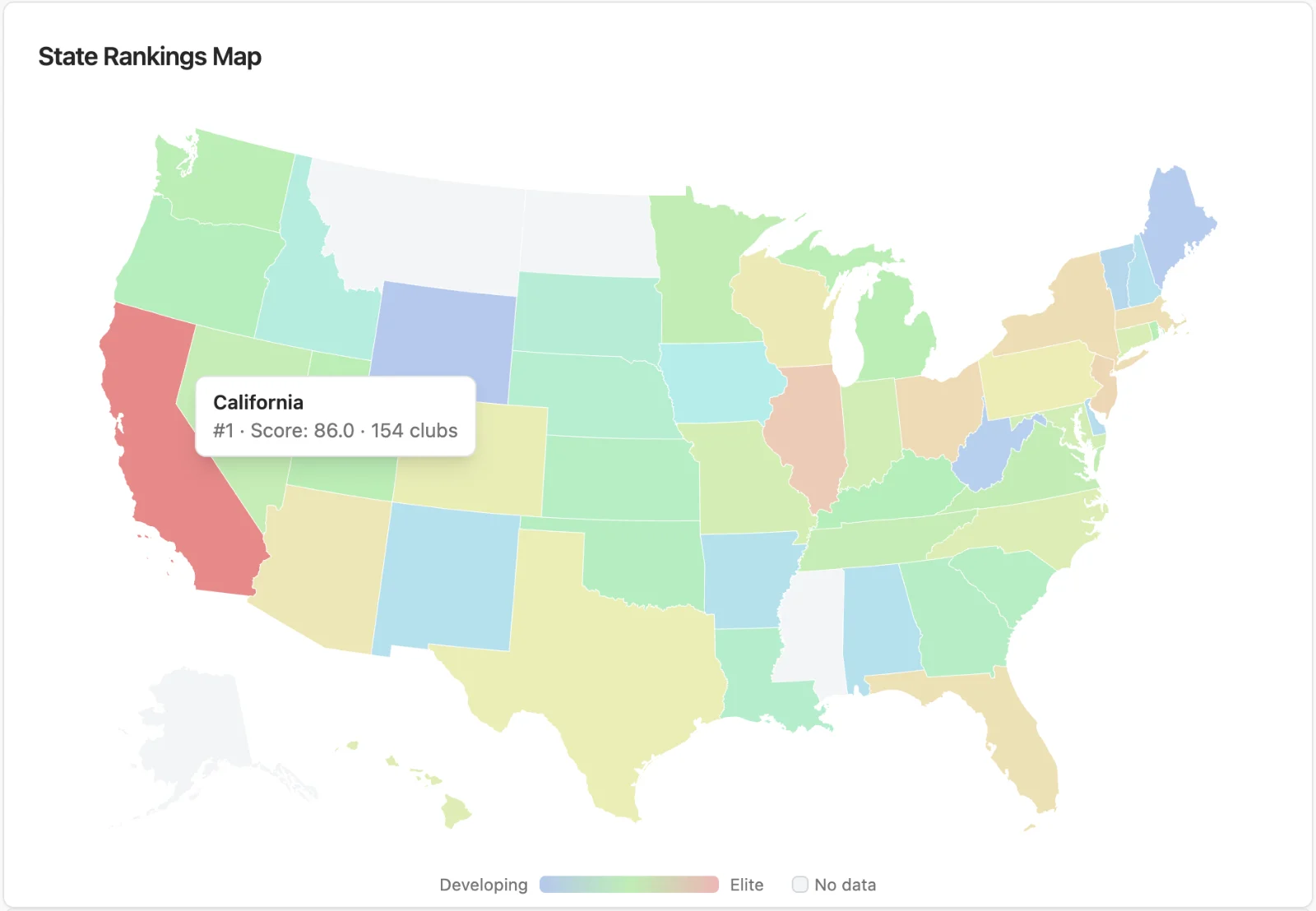
Team results help power insights for clubs, states, tournaments, and broader competitive trends. That means users can explore which clubs have the most depth, which states are producing elite teams, which tournaments had the strongest fields, and which teams are climbing at the right time.
The goal is not just to rank volleyball. The goal is to help people understand it.
State Volleyball Power Score
For state rankings, VolleyLens uses the State Volleyball Power Score, or SVPS, to measure both elite strength and overall depth.
The formula looks at five areas:
Peak Quality measures how strong the best teams are.
Elite Strength reflects how many high-level teams a state has.
Adjusted Average captures broader team quality.
Breadth rewards competitive depth.
Elite Density shows how concentrated elite teams are within the state.
This matters because one great team does not always define a volleyball state. A truly strong volleyball state usually has both elite teams at the top and serious depth underneath.
What Makes VolleyLens Different
VolleyLens is built for people who want more than a static top-10 list.
It is data-driven, dynamic, and transparent. It uses actual match results instead of subjective voting. It updates as the season changes. It gives players, parents, coaches, clubs, and fans a deeper way to follow the game.
No model is perfect. Volleyball has injuries, roster changes, lineup experiments, and tournament formats that can affect results. But a transparent model built on real matches gives the community a stronger starting point than reputation alone.
The Bigger Vision
Volleyball is growing fast, and the data around the sport should grow with it.
VolleyLens is building a clearer view of the game: rankings, teams, clubs, states, tournaments, player context, predictions, and performance trends in one connected platform.
Because the story of a volleyball season is bigger than one weekend, one ranking release, or one opinion.
It is written match by match.
By VolleyLens