Free Volleyball Tournament Software for Indoor, Beach and Grass
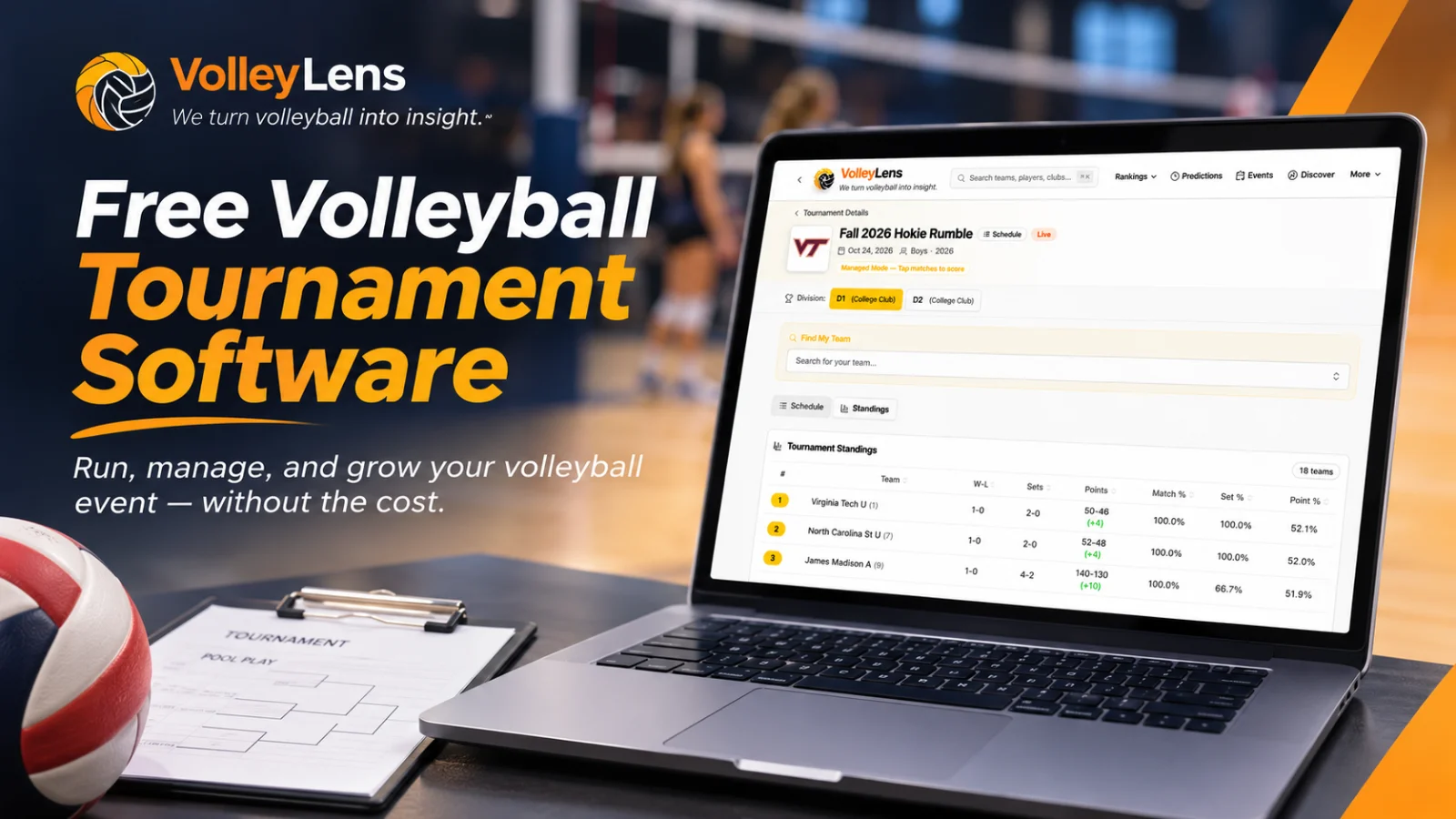
VolleyLens Event Management is free volleyball tournament software — unlimited events, unlimited teams, no card, no trial clock. Run a twelve-team Saturday on it, or a three-day convention-center weekend with six divisions and eight courts.
It’s built inside the ranking platform, so your seeds come from real ratings and your results go back into them. Everything here is live today, and the numbers come from our own production data.
What free actually means
No fee per event. No cap on events, teams, courts, divisions or bracket size. No tier holding back the feature you need. Publishing a tournament costs nothing and always will.
Entry fees are the one place money moves, and we publish the arithmetic. VolleyLens takes nothing from an entry fee. Card processing is 2.9% plus 30 cents, added on top and paid by the registering team — so a $275 entry fee pays you $275, and the team is charged $283.53. Prefer Zelle, Venmo, a check or cash at the door? Collect it yourself and we just track who has paid.
Set the event up in one sitting
Divisions by age, gender and level. Courts named whatever you call them in the building. Hours for each day, and breaks where you want them. Then the teams:
Search the teams we already rank. 60,974 of them, with 848,462 matches behind their ratings. Search results are ordered by rating, so the strongest team with that name is the first one you see.
Or paste your whole field at once. Names we’ve never seen are added exactly as you typed them, in one click, and can be linked to real teams later.
Seed from live ratings. Pools are snake-drafted off each team’s current rating instead of last year’s guess — and then you drag teams wherever you want them. The drag is the save. Nothing you arrange by hand gets recalculated away.
Cut brackets by finishing place. “Top two from every pool to Gold, the thirds to Silver, the fourths to Bronze” is a thing you can say here. A place group goes somewhere whole, so nobody is split out of Gold on a cross-pool tiebreak the gym cannot see.
The scheduler knows who referees
This is the part generic bracket generators get wrong, and it’s the part that decides what time you go home.
A pool running a match needs two teams on court and a third working it. So a pool of six can run two matches at once, and a pool of four can only ever run one — whatever the floor space says. Assign paid officials instead and the cap doubles, because nobody has to sit out.
Here is the same twelve-team event, two pools of six, 45-minute games:
Two courts — 15 time slots, last whistle at 18:30.
Four courts — 8 slots, done by 13:15.
Eight courts — still 8 slots, and only four courts ever get used.
Renting four more nets would have bought that organizer nothing. Hiring referees would have cut the day in half. No other tournament software we have tested will tell you that before you sign the facility contract.
Three more things the schedule handles on its own:
Each pool keeps its own block of courts for the whole event, so teams drop their bags in one corner of the gym and stay there.
Nobody works five slots in a row. Work teams are assigned after every match has a time, which is the only point where you can actually know who plays next.
One Court 1 means one Court 1. Every division books against a single ledger, so two divisions cannot be sent to the same floor at the same hour.
Run the day
Scoring from any phone. Each court gets a link. No app to install, no account to create — hand it to a parent and they’re scoring. A point saves on the first tap, and if the gym wifi drops, the score is held on that phone and sent the moment it comes back.
The whole tournament prints in one click. Cover page, pool sheets, court sheets and a schedule for every team, as one file. Paper is what you want in your hand when the venue’s guest network falls over at 9am.
A public page clubs can actually use. Pools, schedule, live standings and brackets at a shareable URL, updating within about a minute of a score going in. Coaches stop texting you to ask what court they are on.
The day, projected while you can still act on it. The control center runs the clock forward from now and answers the only question that matters at 3pm: will the final be played before the building closes? It also counts the court time still sitting empty, which is almost always where a late day is really going.
And the schedule stays editable after you post it. Re-time a wave, move a team, swap a work team, withdraw a no-show at 8am — all of it is what a tournament director does on the day, and none of it loses a score already entered. Spectators see the change within a minute.
Indoor, beach, grass — and season-long leagues
Courts are whatever you name them, so a sand event runs on Sand 1 through Sand 8 and a grass festival runs on Field A through Field F. Pools, work teams, brackets, scoring links and printed sheets behave identically on all three surfaces.
Leagues are a separate format rather than a tournament stretched thin. Pick dates from September to April, schedule the fixtures, and standings build all season on their own public league page. One organizer account covers both.
Results that count for something
Most tournament software is a filing cabinet: the weekend ends and the scores stay where you typed them. Here, once every match has a result, one click sends your indoor event into the national rankings — the same ratings that seeded it. Teams linked on both sides of a match count; teams you entered as typed wait until somebody links them.
That’s the loop no bracket generator can offer. Your event is seeded by what teams have really done this season, and what happens at your event changes what the next organizer sees. We publish how the ratings are calculated and how accurate their predictions have been, so you don’t have to take any of it on trust.
Run your tournament from Claude or ChatGPT
Connect VolleyLens to an AI assistant and you can run the event by talking to it. Create the tournament, add the field, generate the schedule, record scores, move a team, withdraw a no-show, post the schedule, set the entry fee. You won’t find that anywhere else in volleyball.
Anything that changes something shows you what it will do first, then waits for your yes. It never takes a payment, never deletes an event and never pushes results into the rankings on its own. The connection guide is five steps.
How VolleyLens compares to AES, SportsEngine and Challonge
We read every public page in the field — Advanced Event Systems, SportsEngine, SportWrench, GotSport, LeagueApps, TeamSnap, Challonge, LeagueLobster, VolleyballLife, Scoreholio — on 20 November 2026. Three differences matter.
Price
Not one of them publishes a price on its public site. Every number you’ve heard came from a sales call or a forum post. Ours is on this page: zero to run the event, zero taken from an entry fee.
Who works the match
Bracket generators model courts and times. They don’t model the team sitting out, which is the constraint that actually sets the length of a volleyball day — and six of the ten are flagged for weak refereeing and scorekeeping support in the industry round-ups that rank them. Work-team arithmetic is the first thing our scheduler solves, not a field you fill in afterwards.
Why organizers choose VolleyLens
It costs nothing — and that’s a published policy, not an introductory offer.
It’s as flexible as the spreadsheet you’re replacing. Every default is overridable and every drag saves immediately. We never silently overrule something you arranged by hand.
It plans the day around the real constraint, including the referee math that tells you whether another court is worth renting.
It survives a bad Saturday. Scores hold on the phone through a wifi drop, the whole event prints in one click, and posting a schedule is reversible.
Your results count. Seeded by real ratings, and feeding them back.
Frequently asked questions
Is free volleyball tournament software really free?
Yes. There’s no charge to create, publish or run an event, no limit on how many you run, and no card required to start.
What does collecting entry fees cost?
VolleyLens takes nothing. Card processing is 2.9% plus 30 cents, charged to the registering team on top of your price, so you receive the figure you advertised. Collect by Zelle, Venmo, check or cash instead and no processor is involved at all.
Do scorers need an account or an app?
Neither. Each court gets a link that works in any phone browser. Points save as they’re tapped, and are held on the device if the connection drops.
Does it work for beach and grass tournaments?
Yes. You name the courts, so a sand or grass event runs end to end exactly as an indoor one does. The national rankings themselves cover indoor play.
Can I run a season-long league?
Yes — league play is its own format, with fixtures across months and standings that build all season on a public page.
Can I change the schedule after posting it?
Yes, and taking it back down is one click that leaves pools, times, courts and every entered score untouched. Changes reach the public page within about a minute.
What is not included?
Housing and hotel blocks, and spectator ticketing. Those belong to a qualifier-scale travel operation, and we don’t build them.
Start your first tournament
Create an event, add your divisions, paste your field and generate a schedule — a twelve-team one-day event takes about twenty minutes end to end, and costs nothing to publish. Start from the tournament organizer page or go straight to the events list.
Further reading
The event management guide — pools, brackets, work teams, scoring and printing, step by step.
Registration and entry fees — approvals, waitlists, payment methods and payouts.
Connecting Claude or ChatGPT — the five-step setup and what the assistant will and will not do.
How VolleyLens rates teams — the algorithm your seeds come from.
Written by Leo Marushevskyi, who builds VolleyLens. Running something unusual and not sure it fits? Tell us about it.
By Leo Marushevskyi