Explaining the 8 Governing Associations for College Volleyball
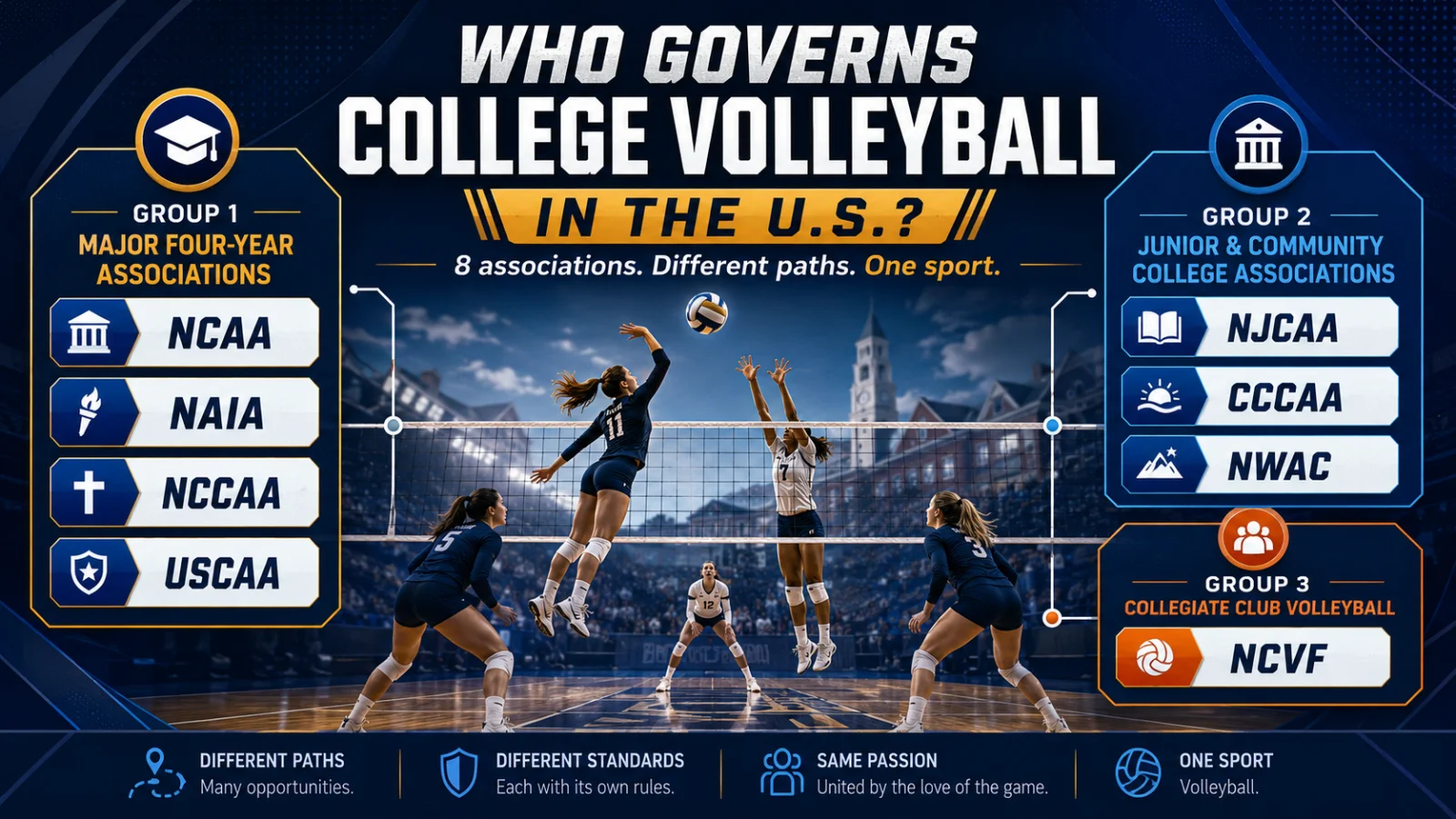
College volleyball in the United States is governed by eight distinct associations. These organizations are separated by school size, philosophy, and geography, offering different levels of competition, scholarship opportunities, and academic environments for student-athletes.
The eight governing bodies can be broken down as follows:
The Major Four-Year Associations
1. National Collegiate Athletic Association (NCAA)
The NCAA is the largest and most prominent governing body for college athletics, divided into three competitive levels:
Division I: Represents the highest tier of competition with the most rigorous time commitment. Division I volleyball teams are permitted to offer athletic scholarships.
Division II: Balances highly competitive athletics with academic pursuits. Schools offer partial athletic scholarships to volleyball players.
Division III: Focused strictly on academics and the broader student-athlete experience. These schools do not offer athletic scholarships, but often provide excellent academic and need-based financial aid.
2. National Association of Intercollegiate Athletics (NAIA)
The NAIA represents primarily smaller, private four-year colleges. It is comparable to NCAA Division II in terms of level of play and offers both athletic and academic scholarships. The NAIA generally has more relaxed recruiting guidelines compared to the NCAA.
3. National Christian College Athletic Association (NCCAA)
The NCCAA is an association of Christian-based colleges and universities. It features two divisions, functioning as a home for faith-focused institutions while granting student-athletes the opportunity to compete at a collegiate level.
4. United States Collegiate Athletic Association (USCAA)
The USCAA is aimed primarily at smaller colleges and institutions, often catering to niche, specialized, or technical schools. It provides national championships for programs that may not fit the scale of the NCAA or NAIA.
Junior and Community Colleges (Two-Year Associations)
5. National Junior College Athletic Association (NJCAA)
The NJCAA is the primary governing body for two-year colleges, community colleges, and junior colleges nationwide. It provides a popular stepping-stone for athletes who need to develop their skills, improve academics, or save money before transferring to a four-year university. It offers three divisions, with Divisions I and II permitting athletic scholarships.
6. California Community College Athletic Association (CCCAA)
Operating exclusively in California, the CCCAA governs community college athletics within the state. It is one of the largest state-specific junior college associations, facilitating robust volleyball competition and providing a pathway for athletes to transfer to four-year institutions.
7. Northwest Athletic Conference (NWAC)
The NWAC primarily serves two-year colleges in the Pacific Northwest—specifically Washington, Oregon, and occasionally Idaho and British Columbia. It functions similarly to the NJCAA and CCCAA, overseeing regional play and championships for community college student-athletes.
Collegiate Club Volleyball
8. National Collegiate Volleyball Federation (NCVF)
While primarily functioning through USA Volleyball, the NCVF serves as the governing body for collegiate club volleyball. This organization allows student-athletes who are not on varsity NCAA or NAIA teams to compete in highly organized, competitive tournaments and national championships against other university club teams
By VolleyLens